Designing a CI/CD pipeline your team actually trusts
Why pipeline speed is a correctness feature, how to sequence checks so failures are cheap, and the difference between a pipeline that gates releases and one people learn to bypass.
By Hardik Kamdar
There are two kinds of CI/CD pipeline. One is a tool the team relies on. The other is an obstacle they have quietly learned to work around, with a shared understanding of which checks can be skipped and which branch protection rule an admin will override when the release is urgent.
The difference is rarely the tooling. It is almost always how long the pipeline takes and how it behaves when something fails.
Speed is not a convenience feature
A pipeline that takes forty minutes changes behaviour in ways that are easy to miss.
Developers stop running it on small changes, so changes get batched. Batched changes are harder to review and harder to debug when they break. A failure in a forty-minute pipeline means a context switch, so the developer moves on to something else and returns an hour later having lost the mental model of what they were doing.
Worse, a slow pipeline creates pressure to make it faster in the wrong way. The integration test suite becomes “nightly only”. The security scan becomes advisory. Each of those decisions is locally reasonable and collectively hollows out the thing you built.
A pipeline under ten minutes gets run constantly. Changes stay small. Failures are cheap to diagnose because the diff is small and the developer is still holding the context. Speed is what makes the rest of the pipeline’s value accessible.
Order checks by how fast they fail
The most effective structural change in most pipelines is simply reordering.
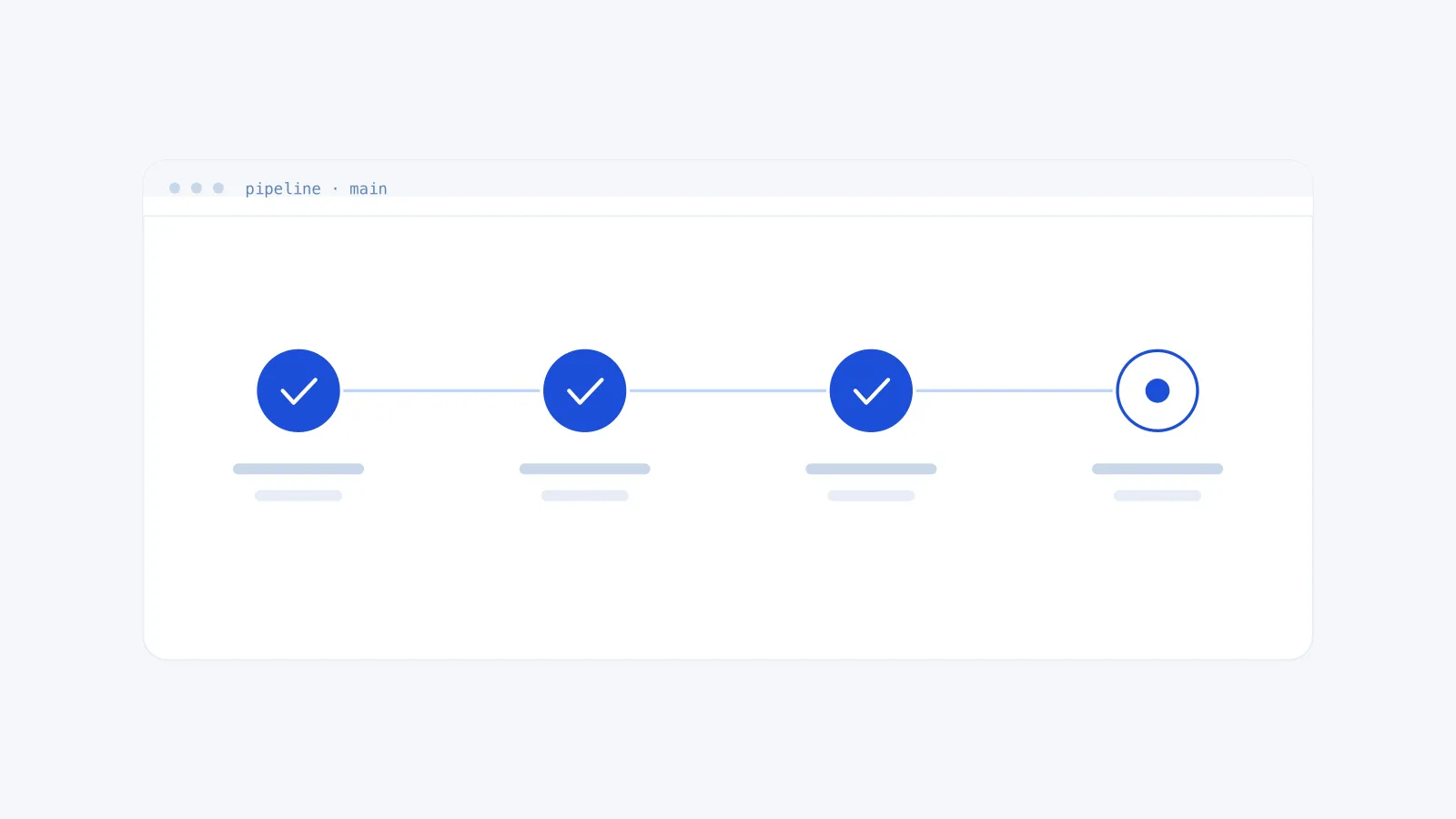
Run the cheap, high-signal checks first: linting, type checking, unit tests, secret scanning. These complete in a minute or two and catch a large share of problems. Then the more expensive stages: integration tests, container builds, image scanning. Then the slowest: end-to-end tests against a deployed environment.
The point is to fail as early as possible. A developer who committed a syntax error should know in ninety seconds, not after the pipeline has spent eight minutes building a container image that was never going to ship.
Parallelise aggressively within stages. Test suites that run sequentially because that is how they were written are usually the single largest source of wall-clock time. Cache dependencies properly, and verify the cache is actually being hit, because a misconfigured cache key silently reinstalls everything on every run.
Distinguish blocking from informational
Not every finding deserves to stop a release, and treating everything as blocking is how teams learn to bypass the pipeline.
A dependency with a known-exploitable vulnerability reachable from your code should block. A moderate-severity finding in a transitive dependency of a build-time tool should open a ticket and let the release proceed. If your scanner blocks on both, developers will start passing the flag that disables it, and then you have no scanning at all.
The same applies to test flakiness. A test that fails one run in twenty is worse than no test, because it teaches the team that red does not necessarily mean broken. Once that belief takes hold, a genuine failure gets a retry rather than an investigation. Quarantine flaky tests explicitly and fix them as their own work, rather than letting them erode trust in every result.
Make the deploy boring
The deployment step is where most of the residual fear lives, and the fix is to shrink the blast radius rather than to add more approval gates.
Deploy small changes often. A release containing one change has an obvious culprit when something degrades. A release containing thirty changes requires bisection under pressure.
Use a strategy that limits exposure while a change proves itself. A canary that takes ten percent of traffic for fifteen minutes, with automatic rollback on error-rate deviation, converts most incidents into a brief blip affecting a fraction of users. Blue-green gives you an instant switch back. Either is better than deploying to everything and watching dashboards.
Make rollback a first-class path that is tested, not a runbook nobody has exercised. If rolling back requires a database migration to be reversed by hand, you do not have a rollback, you have a hope.
The pipeline should produce its own evidence
If you have compliance obligations, the pipeline is the cheapest place to satisfy them.
Every artifact signed, with recorded provenance. Every deployment logging what shipped, which commit it came from, who approved it, which checks passed and what the rollback path was. When an auditor asks how you know a given production version was reviewed and scanned, the answer should be a query against deployment records rather than a week of archaeology.
This is not extra work layered on top of delivery. It is a by-product of a pipeline that already knows all of those facts, recorded rather than discarded.
Where to start
If your pipeline is slow and mistrusted, resist the urge to redesign it wholesale. Measure first: find the single longest stage, and find out whether it is slow because of the work it does or because of how it is configured. In our experience it is usually the latter, and usually caching or parallelism.
Then reorder so the cheap checks run first. Then classify your blocking checks honestly. Those three changes recover most of the value without touching your tooling.
If you want a second pair of eyes on your delivery path, that is what we do.